
Before approving any car repair, ask the right questions. Learn what to ask about pricing, parts, urgency, and diagnostics to avoid unnecessary costs.
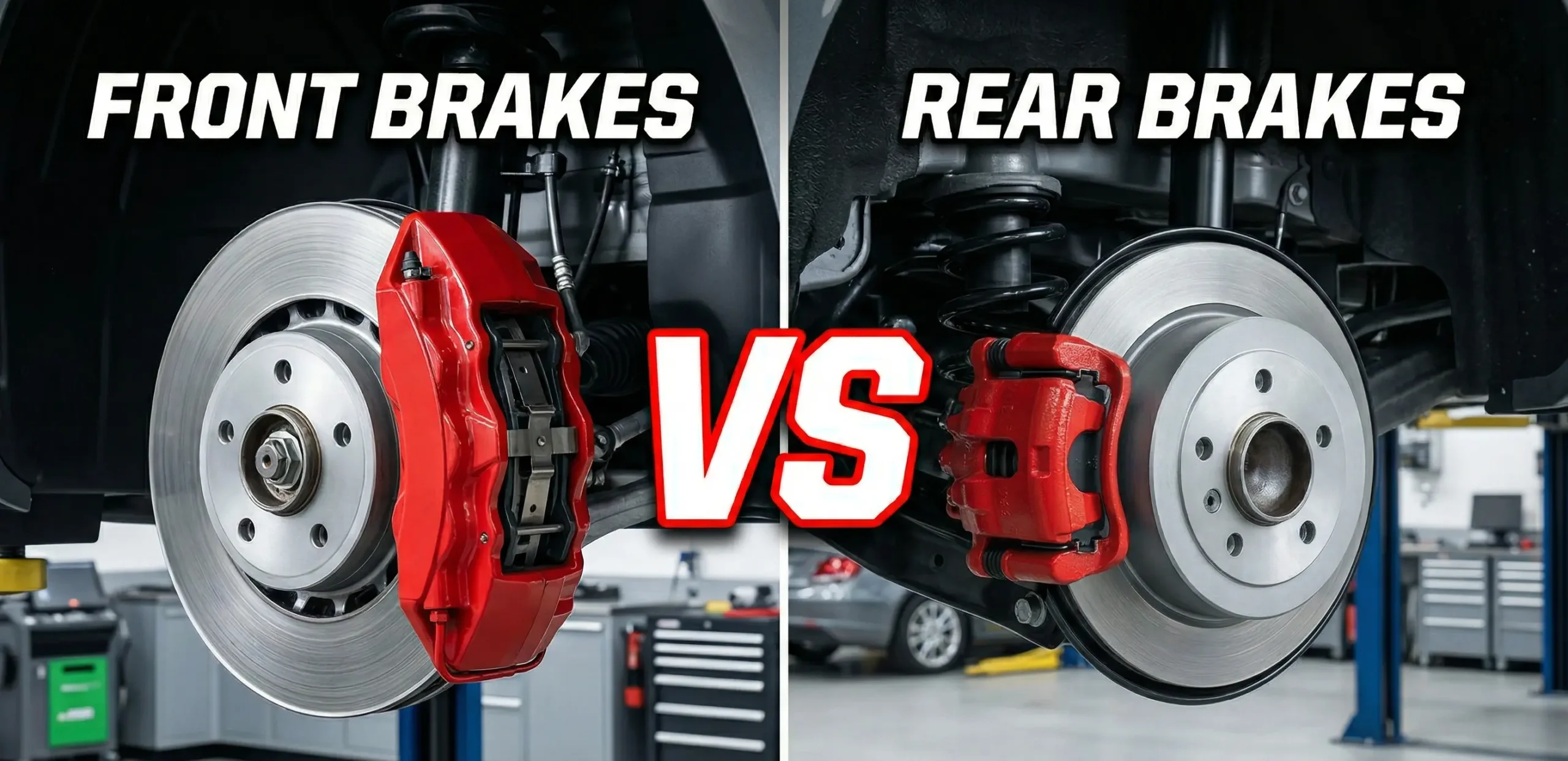
Front Brakes vs. Rear Brakes: Does It Actually Matter Which Ones Get Replaced First?
Most drivers think of brakes as a single system — you press the pedal, the car stops. But your vehicle actually has two separate braking circuits working in coordination, one at the front axle and one at the rear, and they do not wear at the same rate, carry the same load, or fail in the same way. Understanding the difference is not just useful automotive trivia. It has real implications for how you maintain your vehicle and how safely it stops. We at Tower Service Station inspect both axles on every vehicle that comes through our shop, and the difference between front and rear brake wear is something we see play out in real and consequential ways every week.
Why Front and Rear Brakes Are Not Equal Partners
Physics is the starting point here.
When you apply the brakes, your vehicle’s weight shifts forward. That weight transfer increases the load on the front wheels and reduces it on the rear. As a result, your front brakes are doing the majority of the stopping work on virtually every passenger car on the road — typically somewhere between 60 and 70 percent of total braking force, depending on vehicle design and weight distribution.
This is not a flaw. It is an engineered reality, and brake systems are built around it. Front brake components are generally larger, run hotter, and wear faster than their rear counterparts for exactly this reason.
What Wears First — And By How Much
Given the load imbalance, front brake pads almost always wear faster than rear pads. In many vehicles, the front pads may need replacement two or even three times before the rear pads reach minimum thickness.
Here is what that looks like across common vehicle types:
- Front-wheel drive sedans and hatchbacks — most pronounced front-to-rear wear difference; the front axle handles both drive and braking load
- Rear-wheel drive vehicles — still front-biased for braking, but rear wear can be closer to front wear rates under performance driving conditions
- All-wheel drive SUVs and crossovers — weight and drivetrain spread the load slightly, but fronts still typically wear faster
- Vehicles with electronic brake force distribution (EBD) — the system modulates front-to-rear bias dynamically, but cannot fully equalize wear; front pads still lead in wear rate
The gap between front and rear wear varies, but it is consistent enough that checking both axles separately at every inspection matters.
The Rear Brake Misconception That Causes Real Problems
Here is where many drivers go wrong: they assume that because rear brakes wear slower, they can be overlooked for longer.
Rear brakes do less braking work than the front, but they carry a specific and important responsibility — stability. During hard stops, the rear brakes help keep the vehicle tracking straight and prevent the rear end from swinging out. If rear brakes are significantly degraded, the vehicle can become unpredictable exactly when you need it to be most controllable.
Rear brake health is not optional maintenance. It is a stability issue.
Drum Brakes at the Rear: An Older System Still on the Road
Many vehicles — particularly older models and some budget-segment cars — use drum brakes at the rear axle rather than disc brakes. Drum brakes operate on a different principle: curved brake shoes press outward against the inside of a rotating drum to create friction.
Drum brakes tend to wear more slowly than disc brakes and are generally less expensive to replace. But they can be harder to inspect visually, are more susceptible to moisture-related issues, and can fade more under sustained heat load.
When a vehicle’s rear uses drum brakes, the inspection process and the warning signs of wear look different from what disc brake owners are used to — a pulling sensation during braking or a scraping sound from the rear are often the clearest early indicators.
If your vehicle has drums at the rear, they still need regular inspection. The slower wear rate does not mean they last indefinitely.
Should You Replace Brakes in Pairs — Or All Four at Once?
The standard practice is to replace brakes in axle pairs. If the left front pad is worn, the right front pad gets replaced at the same time, even if it has a bit more material remaining. This keeps braking force balanced side-to-side on the same axle, which is important for straight, controlled stops.
Replacing all four brakes at once is not always necessary unless the inspection shows that both axles are at or near minimum thickness simultaneously. That can happen, but it is more the exception than the rule.
What a technician should never do is replace only one side of an axle. Uneven braking on a single axle creates pull and unpredictable behavior under hard stops. An honest inspection measures both sides and both axles, then recommends only what is genuinely needed.
Stopping Safely Starts With Knowing What You Have
Your front brakes and your rear brakes are doing different jobs, wearing at different rates, and giving different warning signals. Treating them as a single interchangeable system means you will almost certainly over-service one axle and under-service the other at some point.
Before booking any brake service, understanding what a thorough inspection actually covers — which measurements are taken, what the technician is looking for on each axle, and what questions to ask before approving any work — puts you in a much stronger position as a vehicle owner.
We at Tower Service Station perform a full digital inspection using Auto-Vitals on every vehicle, including a complete brake assessment across both axles. We use XTremeStop brake pads and rotors — manufactured in Canada to original equipment specifications — so when a replacement is needed, the fit and performance match what the vehicle was built with. You’ll see the full report, know exactly what was found, and understand what needs to happen and why.
If it has been more than six months since anyone looked at your brakes, or if you have noticed any change in how your vehicle stops, call us at 905-574-6166 or reach out through our website. Both axles deserve the same attention.

Related Posts


This Post Has 0 Comments